
 Alumni
 FSOP Ladies
 Harvester & Articles
 Harvester Podcast
 Lectureship
 Lectureship Audio
 Lectureship Video
 Debate
Youtube Video
MP3 Podcast
Chapters
00:00 The Authority of Jesus and Evangelism
08:35 Qualifications for Evangelism: Love, Motivation, and Knowledge
11:43 Overcoming Fear and Excuses in Evangelism
14:37 The Status Quo of Evangelism: Inviting to the Building
17:31 Starting Conversations and Setting Bible Studies
20:37 The Power of Questions in Evangelism
23:38 Developing Interest and Curiosity in Spiritual Conversations
26:41 Practical Approaches to Evangelism
29:28 The Harvest is Ripe: A Call to Action
Transcript *This transcript was automatically generated and may contain errors.*
Lance Mosher (00:00)
Brethren, perhaps you’ve heard of the 80-20 statistic, perhaps the 90-10 statistic. That is 80 %
of an organization’s work is done by 20 % of the people or maybe 90 % of the work is done by 10 % of the people. We are the body of Christ and that should not be the case in the body of Christ. Yet we often see it, don’t we?
But we need to remember that we are not in an organization. We are an organism. We are the body of Christ working together for the growth of the kingdom, the building up of the saints. Yet most of us do see it in the local congregation that the preacher ends up doing the elders work.
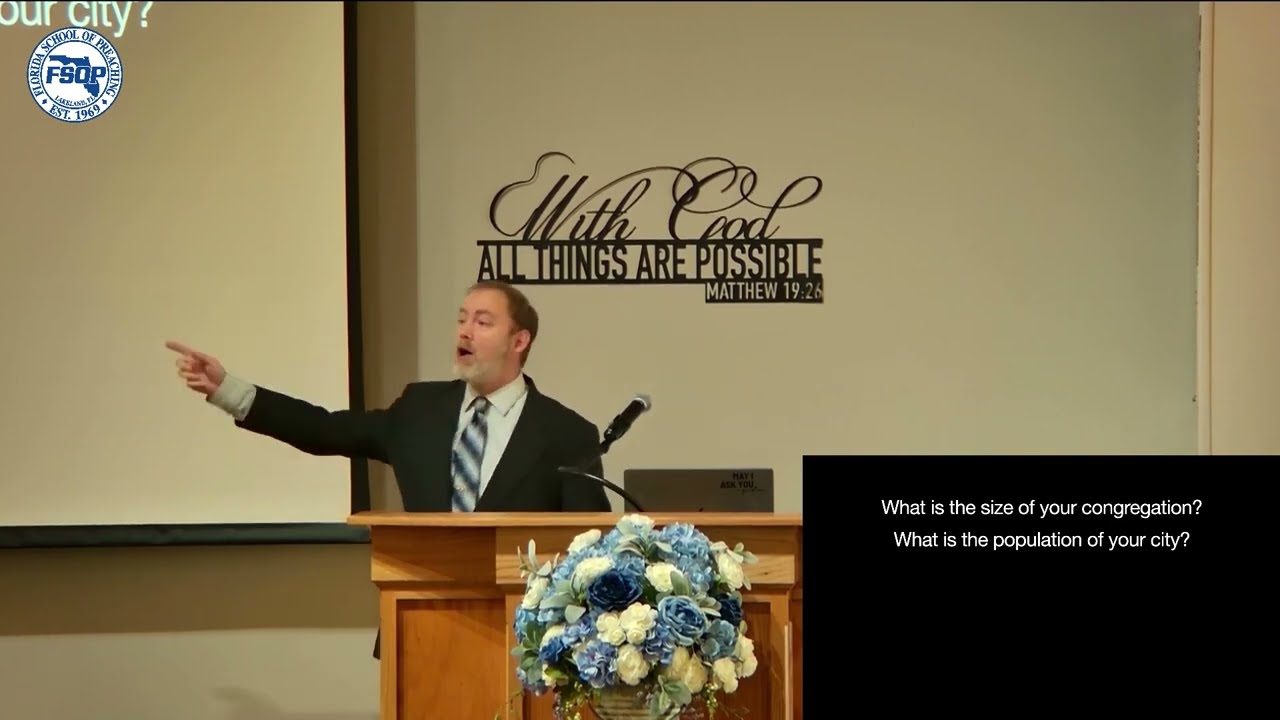
Well, the elders do the deacons work. The deacons don’t know what they’re doing. So the members simply warm the pew. What’s the size of your local congregation? I imagine we have the whole spectrum represented here. You’ve got hundreds. Some of you have less than 50. let’s do a preacher’s count. Yeah, there are 100 people here today. So let’s pretend that we are the local congregation here in this community. And what’s the population of your city? Well, right now we’re in Lakeland. And my extensive research of typing a few words into Google rendered
that there are about 125,000 people living among us right now. How many of those 125,000 does the Lord want to hear and obey the gospel? All of them. And whose job is it? It’s ours. We need to take the gospel to these people. And I know you’re already saying, though, doesn’t Matthew 7 say that there are many on their way to destruction and only few find life? Yes. But when I look at Matthew 7, I see that certainly is a description of how things are. But is it a prescription?
…
This is our opportunity to challenge that status quo in this city. want 125,000 people on their way to heaven. That’s our goal and we’re not gonna stop until we’ve at least given it the opportunity. So what is it going to take? Well, here’s what we’re gonna do. We’re going to pay a preacher. We’re gonna pay a preacher to fill the pulpit every Sunday. We’re gonna pay him a little bit extra because we’re a little bit larger than the average city and he’s gotta beat the streets. He’s gotta knock the doors. He’s gotta spend time in the cafe, the grocery stores, printing those bulletin articles, handing out literature, making sure that
125,000 people know the Lord and we’re going to make sure we’ve got the budget for this. What difference would it make if he reached one person every single year for the next 15 years? I think that’s a reasonable expectation. So we would grow from 100 souls to 115. Praise God for every single soul coming into the kingdom of God. But we also know there’s a challenge to that.
because as we grow by 15, 125,000 is probably gonna grow more than 15. We’re not gonna be able to catch up anytime soon or at all. So what do we do? We need to realize that every member of the body of Christ should be working together. We know from Romans 12, 1 Corinthians 12, and the lessons that we’ve heard this entire week that not everybody’s evangelism is going to look the same and not everybody might be a teacher or a qualified evangelist in that sense, but we should all be working together.
asking together what if all of us could be attributed to reaching one soul every single year. So in theory, what if every one of us, 100, were able to reach one person in 2026? We would grow, wouldn’t we? And we would bypass what the preacher could do in 15 years. In a single year, we would go from 100 to 200. And now we wouldn’t grow the following year by another 100, because now we’ve got 200 saints marching those orders.
Fulfilling the Great Commission. We would grow from 200 to 400. Now I think we’re at capacity. We need a bigger building, 400 to 800. How long would it take us to reach 125,000 people? If I did the math correctly, the preacher couldn’t reach more than 15 in 15 years, but we’ve reached 125,000 in less than 11 years. And if we were the only Christians in the entire world trying to reach 9 billion, it would take less than 30 years
to reach all nine billion. But that only works if every member is working. Matthew 28.
We’ve quoted it several times. Great Commission, go therefore and make disciples of all the nations, baptizing them in the name of the Father and the Son and the Holy Spirit, teaching them to observe all things that I have commanded you. And lo, I am with you always to the end of the age. The astute observer will notice we’ve got verses 18 through 20 cited, but actually only verses 19 and 20 quoted. This is the Great Commission. This is what we quote, right? But what happens when we leave out verse 18?
We begin a conversation with the word therefore. When was the last time you began a conversation with the word therefore? You walk up to somebody the first time of the week and say, therefore, I chose strawberries instead of pistachios.
context, please. And yet this is where we often begin the Great Commission. We need to begin with verse 18, where Jesus says to them, all power, all authority has been given to me in heaven and on earth. Do you believe that? Do you recognize that? Do you respond to the authority of Jesus Christ?
You see the word therefore, what do you do, good preacher students? You find out what it’s there for. Jesus presents his power, his authority, something you agree with, therefore what? Go and make disciples.
Lance Mosher (05:32)
believe that? Do you recognize that? Do you respond to the authority of Jesus Christ? You see the word therefore, what do you do, good preacher students? You find out what it’s there for. Jesus presents his power, his authority, something you agree with, therefore what? Go and make disciples.
As a member of the Lord’s Church, what does it take to be an evangelist? We could probably look at this from many different angles, but I’ve got three qualifications that I have found for an evangelist. I mean, I suppose you could narrow it down to one. If you’re a Christian, you can be an evangelist. In a sense, of course, we understand that there are various roles to play, but I’m trying to simplify it here. But if I could break it down into three, it would be this, love.
We know that we need to be speaking the truth in love, Ephesians 4 verse 15. Do you have love for your own soul to obey the gospel? Do you love your neighbor the way you love yourself? Do you love the Lord with all of your heart, soul, strength and mind? I hope so. Certainly, if you are a disciple of Jesus, you have love. Do you have motivation? Are you motivated for yourself to become a Christian and for your friends and family members to be disciples of Jesus? I hope so.
Romans 1, 16, I’m not ashamed of that gospel. It’s God’s power for salvation. Leading up to that verse, Paul says that I am indebted to preach the gospel both to barbarians and to you also, foreigners and my friends in the gospel.
And I wonder why Paul said that. It probably has something to do with what he says on many occasions. I’m the chief of sinners. Have you seen what God has done with a wretched sinner like me? Because of what God has done in my life, I feel indebted to offer that to other people. Are you motivated to teach the gospel? Love, motivation, what about this? Knowledge.
basic knowledge as well. Don’t let that turn into an excuse. I don’t know the Bible from Genesis to Revelation. I’m not prepared. No, basic knowledge. You’ve probably heard it said or maybe said it yourself. If you know enough to become a Christian yourself, you know enough to tell other people how to do that, how to become Christians.
In 1 Corinthians chapter two and verse two, Paul said, determined to know nothing among you except Christ Jesus and Him crucified. Well, look at it technically. In Acts 18, Paul spent 18 months among these people. And we also see in 1 Corinthians, 2 Corinthians, there were more things that Paul said to these people than simply Christ Jesus and Him crucified. But the idea is everything that I said, everything that I did was to point to that basic fact and to communicate to you that Christ Jesus loves you.
that he was crucified, that he was buried and that he was resurrected and you too can experience that as well. And so therefore I conclude that every Christian is qualified to evangelize, to be involved in the work of the Lord in the community. And this is when we start giving our excuses for why we don’t open our mouths in situations. Here’s what I have said. I’m not very eloquent.
I’m already sounding like Moses, aren’t I? I’m not a very good speaker. When I think of, I could talk to you all day. When I think about talking to my friends and family members who don’t know Jesus, it’s like I’m chewing on bricks. I’m not eloquent. I stumble over my words. I don’t know where to take the conversation. I’m weak. I’ve got all these reasons why it’s difficult for me to even come to an event like this. And so I can’t leave the house or I’m just suffering in various ways, maybe mentally or spiritually or physically.
I’m weak or I’m fearful. Right, Brother Kim? I’m fearful. I’m fearful of I might say the wrong thing. I might push somebody away. I might burn bridges, destroy relationships, or I might get rejected. Those are things that I deal with and those are my reasons why I don’t actually fulfill the Great Commission. When I was a new Christian, I knew the importance of trying to teach people the gospel. And I knew it started the same way somebody did it to me. Would you like to study the Bible with
Somebody asked me that question and I said yes. So I thought maybe I should start asking people that question. But I was terrified of what I would do next. So I was strategic. I went to the people in my life where I knew they would say no. That way if I asked them would you like to study the Bible with me, I’m at least doing my job if they said no, it’s on them. And I would go to people, would you like to study the Bible with me? No. Okay. Would you like to study the Bible with me? No. Would you like to study the Bible with me? No. Would you like to study the Bible with me? Yes.
What do I do next? Someone actually said yes. And so I said, great, not now.
Next week. And so I scheduled it. And I went home thinking, what do I do with this situation? My band had recently played a rock show in Memphis and we had a stack of leftover flyers and that was sitting on my table and I thought, okay, here we go. I flipped that flyer stack over and started working on the back of those pieces of paper and started writing word for word what I was going to say. Have you ever shown up to a Bible study with a manuscript? I have.
And so I went to that Bible study and I, boom, picked up that first sheet of paper and I was shaking. So much so that the paper was rattling. Thank you for agreeing to study the Bible with me today. Smile.
Please turn in your Bible to John chapter three, smile. And she leaned in, are you okay?
It’s not on the sheet. I was fearful. Can anybody relate to being afraid of situations like this?
1 Corinthians 2 verse 2, determined to know nothing among you except Christ Jesus and Him crucified. What did Paul say in that context? He said in verse one, brethren, when I came to you, I did not come with excellence of speech or of wisdom declaring to you the testimony of God. I determined to know nothing among you. Verse four, or verse three, he says, I was with you in weakness, in fear, and in much trembling.
If so, you can relate to the Apostle Paul, we might say one of the heroes of all time evangelism. I was reading a book when I was a new Christian and I loved hearing this, that the average member of the Church of Christ has heard 4,000 sermons. I did the math quickly and that’s what I like to do is try to figure out am I in these shoes yet or not.
This apparently applies to somebody who’s been in the faith for about 20 or 25 years. Now to you all who go to lectureships or who participate in schools of preaching, maybe these numbers are much higher, even if you haven’t been in the faith for 20 years. 4,000 sermons, how many of our sermons touch on the opportunity and responsibility to reach the loss? Even in passing, sometimes completely, that’s the topic of the sermon.
sung 20,000 songs. How many of our songs are about bringing in the sheaves, sowing the seed of the kingdom, ringing out the message, send the light to the work? How many of our public prayers of these 8,000 that we’ve participated in?
are about reaching the lost, or we mentioned, we pray for the 125,000 people in our city and the nine billion people in this world. That’s a good thing that we participate in these things, but the rest of the quote stabbed me in the heart because it applied to me. I don’t know if it applies to you, but he said, he went on to say, and has converted zero sinners.
I don’t know if that applies to you or the average member of your congregation. I hope it doesn’t. But we also want to buck against this because it’s not my job to convert the sinners. I just plant, I just water, it’s God who gives the increase, amen. But what if we change that quote a little bit to attempted to convert zero sinners?
I kidded myself by going to the hard people in my life because it let me off the hook. I wasn’t actually attempting. I was surprised when my work actually succeeded.
And when we talk about evangelism today, this is the status quo. We’ve mentioned it several times this week already. It’s a good thing to encourage members. It was interesting, and I think some of you also found it interesting, that on Monday’s question and answer session, there was a person who actually found it harder to invite somebody to the building than to invite them to Bible study. But for most of us, it’s the other way around. I mean, I can go door knocking all day long inviting people to the building. Hey, we’ve got a gospel meeting starting tomorrow.
We’d love to see you there. Have a good day. But to start a conversation with somebody and invite them to spend an hour with you, you don’t know this person. That’s a little bit more difficult. So let’s just make it easy on everybody and invite them to the building. Nothing wrong with that in most cases. And I think good things have happened even to people in this room because you were invited to a building. But what if that is our status quo? Hang on, it often is our status quo. We say evangelism
is this, inviting people to the building. But I think that breaks down on three fundamental levels. Number one, it’s difficult to get people to the building these days. I don’t know if you’ve noticed that. 100 years ago, we could have a gospel meeting 30 days in a row and have standing room only, but today we have a friends and family day and we celebrate when two visitors walk in through the door. Why is that? We might say that people just aren’t interested in religion these days.
I find that to be hogwash. I get to spend a lot of time with people all day, every day talking to strangers about Jesus. People are still interested, they just don’t express it the same way. 100 years ago, you would go, hopefully, to the Bible with your Bible questions, and if you get stumped, go to the elders of the church, elders of the community, elders of your family, maybe to a church building to explore these things. But today, not so. 100 years ago, if you wanted to be educated or entertained, you had to leave your house. Today, we’ve got stuff in our pocket
that educates and entertains us even in the bathroom.
And we talk about introverts, extroverts, converts. I don’t know where you land on that spectrum, but honestly for me, I don’t think I’m an introvert, but I enjoy isolation. And I’m totally fine with being isolated with myself or with my family all week long. And so if a stranger came up to me inviting me to a strange building among strangers doing strange things and saying strange things, I don’t think I’m inclined to accept that invitation. So maybe we shouldn’t put it on the lost when they reject this invitation.
Maybe they say yes, maybe they don’t. All right, so that’s one way that this breaks down. Number two, just because they crossed the threshold of this building doesn’t mean we’re going to reach them. As Brother Rico said on Monday, bring them here and we can take care of the rest. What is the rest? It’s not just preaching to them, but it’s shaking their hand, introducing yourself, inviting them to somewhere else outside of the building, to your home, to a meal, to coffee, to a Bible study, something beyond just visiting
the building. And the third way that this breaks down, I guess I could have started with this and said, enough said, this ain’t the biblical model for evangelism. The Great Commission is not to sinners to go, but it’s to Christians to go. We are to go to them and teach them the gospel. You know this, I could have, I’ve already wasted your time. You know this, and you know that the real step in personal evangelism is one on one or two on two with some
something
in between you. You’ve got a Bible study going on. And so many of us are asking the next reasonable question. How do I do that? How do I set a personal Bible study with somebody? This next part is going to surprise you. Maybe the pew’s gonna tip back because you’re going to be blown away by all of this. You ready? You gotta open your mouth.
You gotta start a conversation with somebody, whether it’s Aunt Sally, whom you’ve known your whole life and maybe you’ve burned the bridge with before, or that random person in the grocery store. If you wanna set a Bible study with them, you’ve got to open your mouth. First, start a conversation. Now, for those of us who are preachers, maybe the first step is get out of the office. I love office work. I love preparing sermons, Bible classes, praying with people, praying for people, all the good things the elders expect us to do in the office.
But then once we’ve done all that, we like to stay there. That’s our sanctuary. But Brother Hiram reminded us yesterday we shouldn’t be in the business of baptizing our computers. We need to spend time with people and have conversations with them. And another little disclaimer caveat here is we we know we also shouldn’t be leapfrogging other things. If someone’s currently going through a relationship crisis, a medical crisis, financial crisis, we’re not going to ignore that leapfrog over that in order to have a conversation. But we know that eventually
This needs to happen. But then we start shaking in our boots again because we imagine some objections are going to be brought up along the way or questions or comments that we just don’t know the answer to. Or maybe as good preachers or preacher’s wives or whatever you are, maybe you are prepared to respond to when this happens. Well I believe that we’re saved by faith alone.
Or somebody says, don’t you know that science has already proven that the existence of God is impossible? And they’re angry about this because you brought up religion. Or somebody says, I’m very spiritual, I’m just not religious.
Or, I don’t think you need to go to church to be saved. Are we prepared for these objections? I think we are. Are you prepared to answer biblically somebody who claims that we are saved by faith alone? I think so. But before we do, let’s ask this question. What are the goals of this conversation? Is it to inflate your ego?
and to show them your great Bible knowledge, to turn the Bible into a two by four, to beat them over the head until they submit. Of course not. We want to, as every school of evangelism says, we need to develop their interest, right? And I’ve broken it down into this. I want to develop their interest in the gospel where it’s lacking. Wherever they are on their spiritual journey, we’ll talk a little bit more about that tomorrow. We want to move them a little bit closer to asking the right questions. And that’s related to the other sub-goal. want to increase their
curiosity and questions that have real answers. What do you do when you’re curious about something? Well, you Google it.
But what are you doing when you’re Googling? You’re asking questions, you’re seeking answers. And so how would you respond to the question or the objection relating to faith alone? You probably turn into Alexa or your voice assistant. If I’m talking to my boys about certain things and they’re very curious, we might start getting talking about an animal that we’ve seen or heard about and we’ve got questions about them. So we say, Alexa, what is the average lifespan of the American black bear?
Alexa do gives us the answer. The American black bear, the average lifespan is 19 years. And then what do we do with our voice assistant?
We ignore it moving forward. It’s done its job. Please go away. Let me continue in what I was doing before you showed up. And so when we act like voice assistants in our conversation, should we be surprised when we’re treated the exact same way? Imagine how this conversation might go. Well, I believe we’re saved by faith alone. Don’t you know what the Bible says? I mean, James chapter two, let’s go through everything that James chapter two says or Romans chapter six or first Peter 321 or Acts 2216 or Acts 238.
Let me tell you what the Bible says about that. Would you like to study the Bible about that?
Imagine if your voice assistant did that. The average lifespan of the American black bear is 19 years, and then I’m expecting it to shut up, but it doesn’t. It says, and I have come through 25 scholarly articles out of various journals that have studied the lifespan of black bears all the way from Wisconsin and Michigan, even down to Florida, that have come to this conclusion, and the average journal article is 25 pages each, typeface 10 points.
⁓ single space and I’m gonna send you that first article to your email and I expect you to read it and then let me know when you’re finished with that and I’ll just send you the second one. How many of you are gonna follow? You’re gonna go over there and unplug that thing. You’re not interested in what it has to say and yet, you know we do that all the time.
We start giving people what the Bible says, we give them the shortcut, and then we offer them, would you like to study with me for an hour to come to that same conclusion? Best case scenario is they say, ⁓ that’s what the Bible says. Actually, I don’t need to study the Bible, because now I know what the Bible says. But in most cases, we know, don’t we, that we live in a post-postmodern world. The post-modern world said that truth is relative. The post-postmodern world doesn’t need to say it anymore. ⁓
And so they’re going to see that as your opinion, your truth, and if they have a different interpretation or way of life, that’s okay. You have your truth and I have mine. Why would I spend an hour with you already knowing what you’re gonna say in a very uncomfortable situation? It’s just not for me. No, thank you. And so what do we need to do? When people have Bible questions and they’re curious about things, I know this doesn’t sound right, but hear me out. We need to stop telling people what the Bible says.
But instead we need to give them the opportunity to discover the truth on their own. Maybe with your assistance. Because when I tell you what the Bible says, what am I doing? Again, best case scenario, if I’m telling you the truth, I’m putting the Bible back here. And what’s between you and the Bible? I am. That’s not a good situation to be in. Even if they accept everything you say, and even if they become a disciple of Jesus, who are they relying on? You.
not their Lord. And so we need to have this between us where we open the scriptures and explore those questions together. And so that if they have a question about something, how cool is this? If they ask you a question, you go to a scripture, you read the scripture, you ask them their question back to them word for word, and then they’re able to answer it because they have discovered the scripture that answers their question. We need to develop interest, increase curiosity, but when we give them the answer, interest platforms
or decreases and curiosity is satisfied. People want to be listened to, heard, enjoyed, valued, you do too. And so that can be accomplished when we no longer answer questions but actually ask questions. That’s not revolutionary to you but I think we all need the reminder on a very regular basis. When we are evangelizing, let’s flip the script. Instead of answering questions, let’s ask them. Let’s stop telling because when we tell people what we believe,
When we tell people what the Bible says, that’s our interpretation in their mind. They have a different interpretation and debates start. Charlie Brown’s been telling us for decades now, the two things that we don’t talk about, right? Politics and religion. Why? Because people’s political views and religious views are at the core of who they think they are. And when you challenge that, you’re challenging them themselves. But you don’t want to challenge, you want to develop a relationship. So questions I think are often the
most neglected tool, especially those of us who are preachers, because we know the scriptures, at least to these basic objections or questions, and we are so prepared to give them what the Bible says, rather than giving them an opportunity to discover it on their own.
So of course there are two different types of questions. There are open questions and there are closed questions. And when we think about developing interest and increasing curiosity, we want to use open questions more often than closed questions. Just think about this. Do you believe in Jesus? Yep. What are your thoughts about Jesus?
All right, you can’t answer that with a yes or a no. My friend, he was preparing for door knocking and I was part of this campaign and we were trying to prepare these brand new campaigners who had never knocked doors before. We are looking for truth seekers in this city and you’re gonna find them. We’re looking for truth seekers. We’re looking for truth seekers. All right, go. And the first door he knocked, he said, hey, are you a truth seeker? And the guy said, nope. Go, see ya. What do you do with that?
But imagine if he had asked an open question. All right, we go back to this though. If we’re going to try to start a conversation with somebody, Aunt Sally or that random person at the grocery store, how do I start that conversation? Most of us know everything educationally of what we’ve said so far, but how do I go about doing that? What’s the most effective, easiest way I could start a conversation with anybody? Maybe you’ve gone through a school of evangelism that’s trained you in good ways to do that. I’ve got some interesting questions I would like to share with you. That works, but I’ve found an even easier
away from me. Maybe this works for you as well. Again, it’s going to blow your mind how complicated it is. Can ask you a question? Imagine using this question.
in any situation, may I ask you a question? Someone you’ve known your whole life or someone you met two seconds ago. You’re at the checkout line at Dollar Tree and you’re not talking at all or maybe you’ve been talking about the weather and then suddenly you say, may I ask you a question? I believe everybody is now curious enough to say yes or sure. Your uncle’s gonna say, you already did, but you know where we’re going with this, right? The only two people I know who will say no to this are people who are currently
grumpy, they might not be grumpy at you, but they’re having a bad day. And in that case, you don’t want to talk to them about Jesus right now. So you let them know, I’ll come back and ask later. Or people who are just too busy, they’re on their way to do something important, they don’t have time for a conversation. Again, you don’t want to talk to them right then about Jesus. So I’ll come back to you and ask you later. But everybody else is going to give you permission to do what? Ask them a question. What question? Any question at all.
You can say, is the sky blue? You can say, what’s the square root of 1,244? You can say, why did Peter Jackson not include the scouring of the Shire at the end of the return of the king? Yeah, that’s a good question. Or you can say, what are your thoughts about Jesus? Wow, who’s gonna be offended at this?
mean, maybe somebody would be, because they’re already uptight and they think, no, this is gonna be uncomfortable. But what have you, in essence, done? Ask them what they think about Jesus. They might think you’re there to tell them what you believe, but you’re not. You’ve already committed to that. You’re gonna give them an opportunity to just explore this question on their own through the Scriptures. So you’re not there. And you’re eventually going to show them, probably quicker than later, why you’re not there, to tell them what they believe. You’re interested in.
What are your thoughts about Jesus? Now this next one is a mouthful and it’s been used before and I need to remind you of it. In some cases it’s good, in some cases it’s a little bit too heavy, but you might say, if the Lord would return right now, do you know for sure with nothing doubting that you would spend eternity with him? Or may I ask you a question? Here’s one that I’ve been using lately and it’s really good. I heard it from someone else. I’m a curator. All right, I got five minutes left, but brother Rick told me I can have his first 15 minutes. All right, good.
May I ask you a question? And I am a curator. None of this is original to me, so don’t credit it to me. But how about this one? How are you and the Lord doing? Or why do you think there are so many different churches in this city? If you could ask God one question, what would it be? How’s your faith journey going so far?
All right, so you eventually get to the point in your conversation where one of these objections comes up or one of these statements comes up that you don’t agree with, that you think the Bible says otherwise, and you’re prepared to defend the truth, right? I believe that we are saved by faith alone, or science has already proven that the existence of God is impossible. What do you do with that? Again, you ask questions. Memorize these next two questions, keep them in your hip pocket, you’re ready at any time to pull them out.
What do mean by that?
give them a chance to express the way they feel. If they’re mad, they’re not mad at you. They don’t even know what you believe yet. They’re going to express themselves and you’re gonna stay calm because you’re interested in what they think right now. You’re finding out where they are spiritually. And so you can even break it down further than simply saying, what do you mean by that? What do you mean by science? Don’t be defensive. You’re curious here. What do you mean by God? They might start describing this flying spaghetti monster or some grandfather in the sky who’s angry with his children and he can’t wait to snip that very thin thread until they
go to hell. Interesting, I don’t believe in that God either. But anyway, you ask them, what do mean by that? What do you mean by science? What do you mean by God? And then once they express themselves, imagine, just imagine that their definition or their explanation is still not the right thing. What do you do with that? You simply ask, how did you come to that conclusion? I wanna know, what’s your thought process in this? You might find out that they are a student and they’ve studied through this, or you might find out that they’re just disgruntled. Either way,
have a conversation with them and you’re not gonna get mad. And eventually it’s as simple as this. You stop asking questions and you make this declarative statement. I would love to study the Bible with you. You mean after all this and me telling you that I think this is right and I’m ready to defend this, you still wanna spend time with me? I would love to study the Bible with you.
And that’s just a practical way to start a conversation and set a personal Bible study. The average member of the Church of Christ has heard 4,000 sermons, sung 20,000 songs, and participated in 8,000 public prayers. How many sinners are we going to try to convert even today to make sure that that last number doesn’t apply to you and me? All right, I finally got the memo. I’ve been preaching the gospel for I don’t know how long, but I’m supposed to have a poem. And I found one, all right?
turn it over to you guys. Now this poem is by a guy named Lon Woodrum. I don’t know anything about that guy except that he wrote this poem. So if you know something about him that I don’t, let me know. But think about this and let it give you an image of the task that is before us. Deep in the shadow of slumber one night I lay on my bed.
And dreamed I stood on a mountain with valleys before me spread. The valleys were wide and yellow with beautiful waving grain. And a cloud hung back in the distance loaded with tempest and rain. Looking I saw in the valley laborers. But so few. I knew the gathering tempest would break before they were through. Although they were all so busy bending themselves to the work, they saw the storm was approaching and knew that they dared not shirk.
And near the foot of the mountain I happened to turn my eyes and there stood a man whose visage was brighter than sunset skies. He spoke in such tones of sorrow it caused my heart to bleed. Behold, how white is the harvest with reapers so few indeed.
Why are the workers not many? I thought to myself, and then I glanced about me and noticed the mountains were full of men, men who were laughing and joking, playing some sort of game, not seeing how ripe the harvest or heating the storm that came. Soon I could stand it no longer. Listen! I shouted, a mane. The tempest shall soon be rushing over the beautiful grain. Why waste your time and frolic? Look at the gathering cloud. But one of them quickly answered, you’re one of this idle crowd.
Then came the crash of the tempest, the rushing wind and the rain came howling over the valleys, ruining the yellow grain. The heavens were rocked from thunder. The lightning split the skies till we who stood on the mountain covered our poor blinded eyes. Above the crash of the tempest, the voice of the stranger broke. Behold the ruin of the harvest. This is the heathen, he spoke.
The storm that so widely rages is God’s judgment day. And I woke and wept in repentance as there on my bed I lay, calling on God in the heavens with contrite spirit I prayed, Lord, I will be a worker too long, too long have I played. Because of the ripened harvest I give you my heart and my arm. I’ll spend my strength in the valleys to save the grain from the storm.