
 Alumni
 FSOP Ladies
 Harvester & Articles
 Harvester Podcast
 Lectureship
 Lectureship Audio
 Lectureship Video
 Debate
Youtube Video
MP3 Podcast
Summary
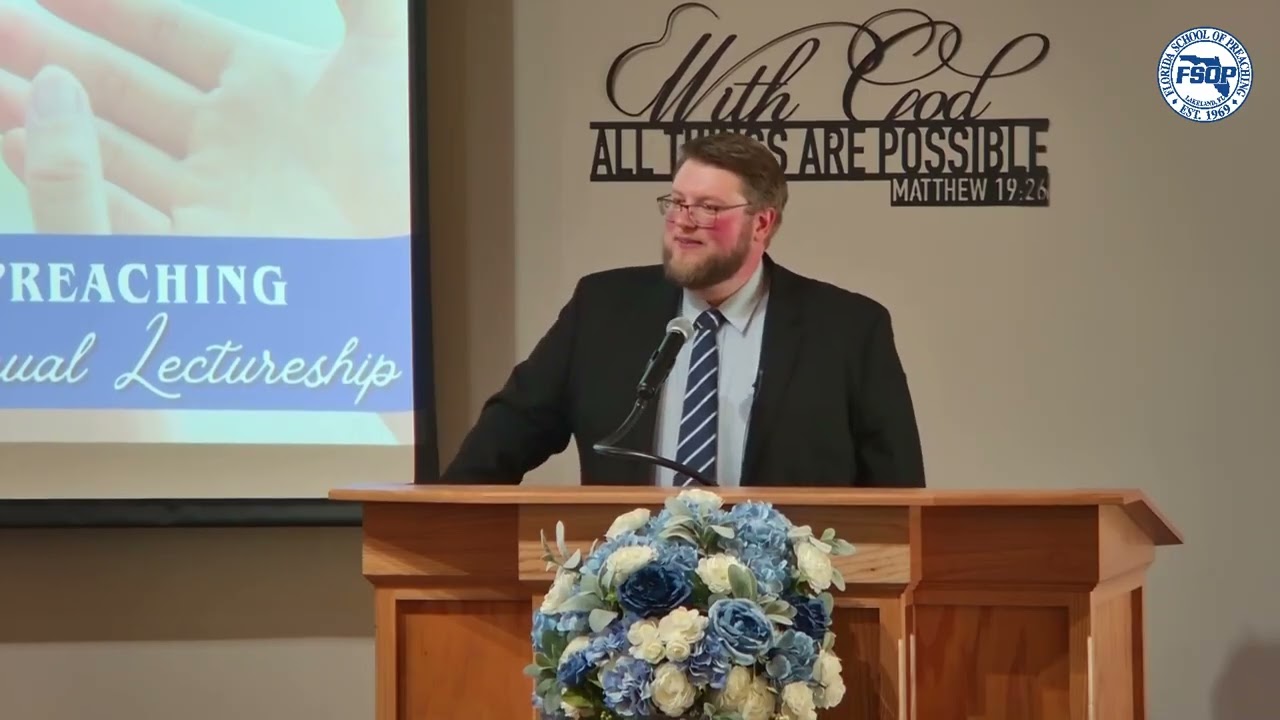
In this conversation, Dylan Johns discusses the importance of internal local church evangelism, emphasizing the collective responsibility of all members to engage in outreach. He addresses common misconceptions and lies that hinder evangelistic efforts, such as the belief that it’s someone else’s job or that people aren’t interested in spiritual matters. Johns encourages listeners to overcome personal barriers, redefine success in evangelism, and take practical steps to foster a welcoming environment for visitors. He concludes with a call to action, urging individuals to stop believing the lies about evangelism and start believing in the promises of God.
Chapters
00:00 Gratitude and Personal Reflections
00:33 The Nature of Lies We Believe About Evangelism
02:21 Understanding Our Role in Evangelism
07:46 The First Lie: It’s Somebody Else’s Job
14:55 The Second Lie: I’m Not Cut Out for Evangelism
18:30 The Third Lie: People Aren’t Interested
19:22 The Fourth Lie: Evangelism Can Wait
20:49 The Fifth Lie: Evangelism Doesn’t Work Anymore
23:48 Practical Steps for Effective Evangelism
26:35 Conclusion and Call to Action
Transcript *This transcript was automatically generated and may contain errors.*
Dylan Johns (00:05)
Can’t begin to tell you how grateful I am for your prayers for my mother-in-law. ⁓ Please, pray for her, pray for her husband, pray for my wife and my sister-in-law, and for me, if you would. ⁓ I greatly appreciate it. I learned a lot while I was a student here, but one of the main things I learned was no one ever got fired for quitting early. ⁓ short and sweet is the goal. I don’t know about the sweet part, but short, probably.
In Romans chapter one, verse number 25, Paul writes of those outside of Christ that they have traded the truth of God for a lie. I think it is human nature or whatever you’d like to call it to believe a convenient lie versus a hard, difficult,
truth and we do it all the time in little ways. You open up a bag of chips and what do you say to yourself after you’ve eaten 10, 20, 15, 50? Just one more, right? And you say that to yourself 10, 20, 30, 50 more times and you keep lying to yourself. When it’s time for bed and you know you’ve got to be up early the next day and you’re watching television you say just one more episode and I’ll call it a night. And well before you know it one episode turned into a whole season of television and
It’s time to go to work already. And sometimes we tell ourselves bigger lies that help us cope or give us confidence. Sometimes we say, you know, I can handle that. Nothing is wrong. Or we say, you know, if I just had this thing, my life would be so much better. Or if I could just do this one thing, all my problems would go away. Those lies make us feel better.
The topic this afternoon is internal local church evangelism. And when I saw Brian’s email with that topic, I didn’t know what that meant. I still might not know exactly what that means, but thankfully he gave me a brief outline of what we ought to be talking about this afternoon. What that really means is how do we get everybody in the congregation involved in evangelism? How do we make sure that it doesn’t just become the job of a few select individuals?
And as I thought about that topic, I firstly thought, well, maybe we ought to talk about some methods. If we could just get material in people’s hands, maybe that would solve the problem. But, I don’t think we lack material. If you’re lacking in an evangelistic method, I think it would take about five minutes to find a pretty good one. Then I thought, well, maybe we ought to talk about the importance of evangelism. Maybe we just don’t understand how important it is. But you wouldn’t be here on a Tuesday afternoon.
if you didn’t know evangelism was important. So I thought, well, maybe we ought to talk about some important scriptures. Maybe people, if they just had a cheat sheet worth of scriptures that they could carry in their pocket all the time, our evangelistic efforts would just explode. And certainly, we could always know more.
But I don’t think the problem is that we just don’t have the right few Bible verses memorized. And so I wondered, what really is the problem? Why is it that we often fall short in evangelism? I think the problem is what Paul says in Romans chapter one, verse number 25. We have begun to believe some convenient lies.
about evangelism. Rather than owning up to the harsh truth that it is all of our job and that it is a difficult job but a worthwhile one, we tell ourselves little lies that lets us off the hook sometimes. And so what I’d like to do this afternoon is deal with about five of those. Five lies that we tell ourselves about evangelism. And the first one is probably going to be the most obvious one, but it’s the biggest one. And that is that it’s somebody else’s job. We would never say that, right?
We all know intellectually we have a responsibility, and if you didn’t know that by now at this lectureship, I think you do. But we act that way, don’t we? I think about it’s like doing the dishes. know, after dinner, you take your dirty dishes to the sink and you put them in and you think, I think my wife will handle it tonight.
I think it’s her turn. Your wife comes to the sink with her dirty dishes and she says, I think it’s our son’s turn this evening. Your son comes to the sink and he puts his dirty dishes in there and he says, I think it’s my little sister’s turn. And your little sister comes and she puts her dishes in the sink and she says, well, if it was my turn, certainly somebody would have told me. And so she puts her dishes in the sink and goes off to bed and next morning there’s a sink full of dirty dishes. You know, in the church, I think we think the preacher will do it. That’s why we pay him.
the big bucks to handle it. And as Hiram will talk about in just a moment, preachers, believe it or not, keep pretty busy. They’ve got a lot on their plate. So maybe the preacher thinks, well, that’s really the job of the elders. They’ll handle it. And the elders might say, well, we’re more management. We handle the bigger picture things. It’s more boots on the ground. The deacons can handle it. And the deacons might say, well, if it was our job, somebody should have told us. And the members say, well, I’m too old.
I’m past that now. Let’s let the younger folks handle that. And the younger folks say, well, I’m new. I don’t know enough. I’ve not done this before. Nobody’s ever showed me how. I’m going to leave it to the more experienced people. And the buck just keeps getting past. And maybe a little bit of evangelism slips out here or there, but it’s often coincidental and not intentional.
We would never say that it’s somebody else’s job to be evangelistic, but we certainly act that way sometimes. In 1 Corinthians chapter 12, Paul talks about the church as a body, and it’s a passage that I’m sure we are at least vaguely familiar with, but 1 Corinthians chapter 12, pick up with me in verse number 14. 1 Corinthians chapter 12, beginning in verse number 14,
Paul says this, for the body does not consist of one member, but of many. If the foot should say, because I am not a hand, I do not belong to the body, that would not make it any less part of the body. And if the ear should say, because I am not an eye, I do not belong to the body, that would not make it any less part of the body. If the whole body were an eye, where would be the sense of hearing? If the whole body were an ear, where would be the sense of smell? But as it is, God arranged the members in the body, each one of them, notice this, as He chose.
Verse if all were a single member, where would the body be? As it is, there are many parts, yet one body. Is that true? We know it is. But you know, sometimes I think I’d like to be the appendix maybe.
You know, they just recently found out the appendix actually does do something. I couldn’t really understand what the article was saying, but it does do something. There is no useless part of the body. Now, every part doesn’t do the same thing, but every part has to work together for the body to do what the body is meant to do.
And so evangelism is not one size fits all. When I think about evangelism, my mind probably immediately goes to door knocking. And that might be the most discouraging, most difficult way to practice evangelism. But evangelism is not always pounding doors on the floor to sun in the summertime, getting doors slammed in your face for eight hours. There’s other things that we can do. And so evangelism is not somebody else’s job. It’s my job. It’s your job.
Somebody has to do it. The lie that we tell ourselves secondly is that I’m just not cut out for evangelism. Yes, I know I need to do it. Yes, I know every Christian is expected to, but I just, I can’t. I don’t know what to do. I don’t know what to say. I don’t know where to go. I don’t know how to do it. And that’s reasonable.
It is not easy. If it was easy, we wouldn’t be here. We wouldn’t be having this lectureship. But we’re all cut out in some way for evangelism. I don’t know about you, but I pray often, Lord, give me an opportunity to be evangelistic today. And I hope that’s a prayer that we all offer up. But when we offer that prayer, what does the answer to that prayer look like in our minds? When we pray that, what are we actually asking God to do?
Lord, give me somebody who will pound on my door begging me to baptize them right now. That’s the opportunity I have in my mind when I pray, Lord, give me an opportunity. Send somebody kicking and screaming, begging to get in the water. Does that often happen?
I don’t know that that’s ever happened. Maybe it has. So what are we really praying for when we say, Lord, give me an opportunity? Only I know that for me, and maybe only you know that for you, but do we think that God doesn’t give us opportunities? We know he does. We just have to find our place in that, and I want to be very practical in this lesson, but I don’t know what you can do and can’t do.
I don’t know the specifics of your congregation. We could go through a list of a hundred things that maybe you could do, maybe you could try this, but I don’t want us to just throw things against the wall this afternoon and see what might stick and what might not. But think about, spend some time this week or next week after the lectureship thinking about what can I do? What am I maybe halfway decent at that could be useful? And we know some of the familiar things. A card ministry, can you write words in the English language?
If you can do that and if you can afford a 50 cent stamp, you can send somebody a card. Do you have access to the internet? If you don’t, you can go to the library. I think it’s still free. You can have access to the internet. You can share the gospel with somebody on there. Facebook accounts, I think, are still free. You can do something. I can do something, but maybe I don’t spend enough time thinking about exactly what it is I can do. I can tell you all the things I can’t do.
But what can I do? If I’ve never stopped to think about that, then that explains my problem. One of the big things, especially one of the things that I talked about in the book, is about how being friendly is, I think, the easiest and most impactful way to be evangelistic. Does your congregation ever get a visitor? We live in Florida. A lot of people come down here. A lot of people come stay with families, and maybe they come and visit. A lot of people are moving down here. They’re looking for churches. If you’ve ever gotten a visitor,
What are we doing with that visitor? I will never forget one time my wife and I went up to Savannah, Georgia, and I won’t mention the name of the congregation, but it was a Wednesday night and we walked in and, you know, preacher time. I try to be about 10 minutes early. So I walk in 10 minutes early and there’s about five or six people sitting there in this cold, dark room. Half the lights are out, you know. And we walk in and everybody turns around and look at us like the good people of Tokyo look at Godzilla coming up out of the water.
wide-eyed, horrified that somebody had just walked into their church building on a Wednesday night. And we sat down and, do you think anybody came up and said hello?
No. After the Bible class, we sat there for a moment. Nobody came over, so we got up and we left. And that’s not the only time that’s ever happened. That’s not the only place we’ve ever been where that’s been the case. Now, if I asked you, is your church friendly, anybody here gonna say no? We all think our church is friendly. And our churches probably are friendly, but we’re friendly to one another.
I’ve got my little group that I go and I talk to and we get along and we have common interests and I’ll go mingle with this group sometimes and we get along pretty well. But are we friendly to the people on the outside? You the greatest evangelists in the world might be able to get people in our church buildings, but what are they gonna find when they get there? We’re gonna look at them with eyes like saucers. We’re gonna pretend like we didn’t see them walk in and hope that they get out before I have to.
go out the back door. What good is that? If we can smile and if we can shake hands with somebody, that’s evangelism. If we can treat the visitor like we actually maybe care about him a little bit, that’s evangelism. And maybe that’s your role in evangelism. Maybe you’re not the person going out and doing the studies and knocking the doors or posting online or doing whatever, but maybe when a visitor does come, you can say, hi, my name is whatever.
Would you like to sit with me? What brings you in? Maybe I can find something in common with them. And we’ll talk more about how we can maybe take advantage of those opportunities in just a moment. But it’s been mentioned, I think, in just about every lesson to this point, but the Samaritan woman in John chapter four. Would you expect that she could do anything for the kingdom of God? Her profile doesn’t look very good, does it? She’s an outcast, she’s been married more times than anyone should be married.
Yet she goes into the village and what have we seen so many times so far this week? She goes in, she says, I met a man who knew everything. He is the Messiah. Come and see. At least that’s the paraphrased version. And this whole town knew. But I think specifically also about Moses. In Exodus chapter four, I think we know the story. God goes to Moses and he says, Moses, you are going to lead my people out. And Moses says, no, thank you.
He says, I can’t do this, I can’t do that, I’ve got this problem and that problem. And you remember the last excuse, the last line of defense that Moses had was what? You remember?
He says, I can’t speak. It’s funny, he’s been talking to God this whole time, but he says, I don’t know how to talk well to people. I’m not eloquent. Look at verse 10 of Exodus chapter four. Moses said to the Lord, my Lord, I am not eloquent, either in the past or since you have spoken to your servant, but I am slow of speech and of tongue. Then the Lord said to him, who has made man’s mouth? Who makes him mute or deaf or seeing or blind? Is it not I, the Lord?
Therefore go and I will be with your mouth and teach you what you shall speak.” Instead of focusing on the things that I can’t do, and trust me that is a long list, I remember the one who goes with me, the one who has given me any ability that I might have. Lie number two, I just can’t do anything. I’m not cut out for evangelism. That’s what Moses said, but God knew differently. Lie number three is that people just aren’t interested.
in spiritual things anymore. You know, I would be evangelistic, but it’s just a waste of time. The world is just a terrible place these days. And we are the last good people on planet Earth. It’s sometimes the mindset we take. It’s just us. Everybody else is just too far gone. Is that true? You know, I think the number of people that are anti-religion, I think, has grown. And what we often see is that there is this very vocal minority.
that we hear about and we think about. And this very small percentage gives us an impression of what we think the larger population is. So there is no doubt that church attendance is down. People are more anti-religion, maybe than ever before, at least here in this country. But you know, people are still interested in spiritual things. Only about 5 % of the population in this country identify as atheists. Five out of 100 people say, there is no God, and I’m relatively certain about that.
29 % say that they’re just not religious. Maybe God exists, maybe he doesn’t. I just never thought about it. I don’t really care about it. It’s whatever. And the rest, I’ll let you do the math on that. 60-something percent are, in some way, spiritually minded. But we don’t need the numbers to know that, do we? Think about your area. Are there denominations in your area? How are they doing?
You know, in our area, and it is a growing area, it’s still, it’s kind of odd. You drive past a bunch of cow fields and then you’re in a downtown. It’s a growing area. It’s rural, but not really rural. There are churches that can’t find space for people. I drive past a bunch of them on the way to our building, First Baptist Church in Mount Dora. They can’t find space for people to park their cars. They’re building a massive community church five minutes from us down the road.
And I talked to someone recently, my wife and I are kind of in the beginning process of maybe buying a house and so we’re going around talking to the sales guys or whatever and he wants to be nice and friendly so we’re making conversation and he asked what I do and I tell him, actually I preach for the Sorrento Hills Church of Christ just down the street. We’d love to have you. And he said, well actually I’m an elder at the So and So Community Church in Orlando. And I said, wow really? He said, yeah I’m one of 24 elders. And when we first started going there 15 years ago there were about 200 members.
And now we’re up to about 5,000. We’ve got 18 satellite campuses all over the state. We just opened one in Jacksonville. We’ve got 500 kids in our youth group. We support missionaries. We send $100,000 a month to benevolence.
And we say people just aren’t interested in spiritual things.
It’s not true. People are open. 82 % of people said that if their friend invited them to a worship service, they would come. So think of 10 people that you know that are unchurched. The statistics say eight of them will come with you if you just ask them to. But are we asking? It’s easy to write off people. They’re different. They think different. They’re too far gone. They don’t care.
Jesus said in John chapter four, verse number 35, the fields are white for harvest, and that’s still true. There are people out there who do care, and that if we talk to them, they will listen. Lie number four, evangelism can wait. Yes, it’s important. Yes, I know I need to do it, but I’m just so busy right now. My life is hard. I got work, I got kids, I got sports, I got, you know, fill in your own blank. When I get more time,
I’ll start to think about it. And we say that, and we push the can, kick the can down the road until, you know, where that guy standing in the foyer that I think, unfortunately, every congregation has saying, I remember when I was a boy, 60 years ago, this congregation had 500 members, and it’s a shame what’s happened here. We’re down to 20 people, 20 members.
And I wonder, I think about myself. I’ve grown up around the church my whole life, pushing 30 years. What have I been doing for the last 30 years? Am I going to end up being the one saying, it’s a shame, what’s happened here? Somebody should have done something. Or am I going to be the one that actually begins to do something? Evangelism can’t wait. It is a, as was said yesterday, a must for the Christian. Not a want or a desire, but something that must be in our lives.
Paul says in 2 Corinthians chapter 6 and verse number 2, tomorrow is the day of salvation, doesn’t he? Today is the day of salvation. It is still the day. James says in James chapter 4 verse number 14, you do not know what tomorrow holds. And that’s the verse where he says your life is but a vapor. Use the day that God has given you to do something. I think about Felix in Acts chapter 24.
You remember, Paul comes to Felix and he preaches to him the gospel. And the Bible says that Felix began to tremble. He was terrified of what Paul was saying. And so he decided, I need to do something now. Right? He says, go away. Maybe some more convenient time. I’ll hear you again on this. And as far as we know, he never did. He did what we all are tempted to do. Delay, delay, delay until we can let ourselves off the hook.
Line number five is similar maybe to the third one, line number five, evangelism just doesn’t work anymore. You know, we tried that 30 years ago, nothing happened. We sent out those mailers, we spent 300 whole dollars on that, and not a single person got baptized. So why would we do that again? We went door knocking last year, I thought, and I don’t see anybody new. Why are we going again this year?
It’s easy to get discouraged. I think I won’t say it is the most discouraging thing about being a Christian, but perhaps it’s at the top of the list. Rejection hurts. Part of being a human being and having emotions is that it’s not fun to get hurt. It’s not fun to get rejected. It’s not fun to do difficult things. And so perhaps when we try things and they don’t work, well, we don’t want to get hurt again. In 1 Corinthians chapter three, beginning in verse number six,
I like to read what Paul says about the role of himself, but by extension, I think of everyone who follows after the Christ. 1 Corinthians chapter 3, beginning in verse number 6, Paul says, I planted, Apollos watered, but God gave the growth, or God gave the increase, your version might say, so neither he who plants nor he who waters is anything, but only God who gives the growth.
When we reframe our view of success and evangelism, I think we’ll stop being so discouraged all the time. If we define success as getting somebody in the baptistry, we are only ever going to be disappointed for the most part, aren’t we? But if we define success as carrying out the will of God, then we’ll always win. We’ll always be pleased with our efforts. If all I want to do is what Jesus has told me to do, anytime I do that, I’ve won. Mission accomplished.
It’s up to that person how they respond. God will give the increase. As long as I plant in water, it’s up to God. In Isaiah chapter six, verses eight to 13, you remember God asked this question, maybe not directly to Isaiah, but probably to Isaiah. Who shall I send?
whom will go forth? And Isaiah famously says, here I am Lord, send me. And do you remember the mission that God gives Isaiah? As soon as Isaiah stuck up his hand and volunteered, I’ll do it. What’s the mission? Isaiah go preach to these people who will not hear. Isaiah go preach to these people who cannot see. Isaiah go preach to these people who are dull of heart. You think Isaiah maybe put his hand down and said, wait a minute.
I don’t know if I want that job actually. What’s the point? Lord, if they won’t hear me, why even go? Is that not maybe our same attitude sometimes?
But that was not the mission. The mission was to go and to preach. And once Isaiah did that, mission accomplished. How Israel responded was between them and between God. Now I’d like to spend the last couple of minutes that we have quickly talking about some very practical things that we can do. What can I do? And I think at the end of a lesson like this, maybe we’re all expecting the trick. Tell us the secret. If there is a secret, I certainly do not know it.
I don’t think there is one. I don’t think there’s a secret thing that they’ve just not told us that we need to start doing that will work every time. I think the only way to be evangelistic is to actually go and be evangelistic. Engage with people in some way, whether that’s face to face, online, some other way. The only way we can be evangelistic is to reach people. How you do that, that’s up for you to decide and determine. But we need to talk with people. We’ve become so… ⁓
comfortable in our ivory tower perhaps of holiness where we don’t want to step down into the real world and engage with people. But unless we do that, nothing will happen. Pray specifically is the second thing. Don’t just say, Lord, give me an opportunity. I mean, keep doing that. But Lord, help me reach this person. I’ve got a coworker. I’ve got a friend. I’ve got a family member. Pray specifically for that person.
Because the more you pray for one specific person, the more you’ll see more specific opportunities to reach that person. Instead of just leaving it as some vague generality, pray for specific people. Be a church that welcomes people. I know we just talked about it, but I think the best thing that each individual member can do is just be friendly when we do inevitably get a visitor.
Try to connect with them. Maybe find common ground. See what they’re interested in. You like to golf? Hey, so do I. You like to fish? Me too. Let’s get together sometime. Or if you don’t like the things that they’re interested in, maybe there’s someone in the congregation who does. You’re into exercising? Not me, but I know somebody. Maybe you guys can go for a run together or something. Instead of just saying, great to have you, come back if you ever feel like it.
Follow up, connect with somebody in a meaningful way.
And then the last thing that I thought of is something that was said yesterday. believe Brother Zachary mentioned this, but as a congregation when we plan events, and hopefully we are planning events, let’s plan things that we can invite people to come to. A lot of people aren’t comfortable coming into a church building, but people will go with you to go fishing. People will go with you to go watch a movie or go do something. And it’s at that point that we get to know people, develop a relationship that…
we can actually maybe make a difference in their lives. I think I felt victim to the classic preacher blunder. I told you I was gonna be short. I think I left you one minute. But that’s still technically short. We know what happens when we don’t evangelize. We see it all the time. You end up with a church building with five or six members, the grass is waist high, half the letters on the sign are missing. It’s a place that outsiders probably don’t wanna be.
Before we fall into that hole that eventually becomes a grave, let’s begin to do something. Let’s stop believing the lies about evangelism that Satan has told us and begin to believe the promises of God. Thank you for your time.