
 Alumni
 FSOP Ladies
 Harvester & Articles
 Harvester Podcast
 Lectureship
 Lectureship Audio
 Lectureship Video
 Debate
Youtube Video
MP3 podcast
Summary
This conversation explores the journey of the early church as depicted in the Book of Acts, focusing on the spread of the Gospel from Jerusalem to the Gentiles, the challenges faced by Paul and Barnabas during their missionary journeys, and the importance of being adaptable to God’s direction in ministry. It highlights key events such as the Jerusalem Council and the Macedonian Call, emphasizing the need for flexibility and responsiveness to divine guidance in spreading the message of Christianity.
Chapters
00:00 Coming Under Jesus’ Authority
19:49 Responding to Divine Guidance
27:33 Flexibility in Ministry
34:35 The Importance of Open Doors
40:38 The Macedonian Call and Its Implications
Transcript *This transcript was automatically generated and may contain errors.*
Melvin Otey (00:06)
Good evening.
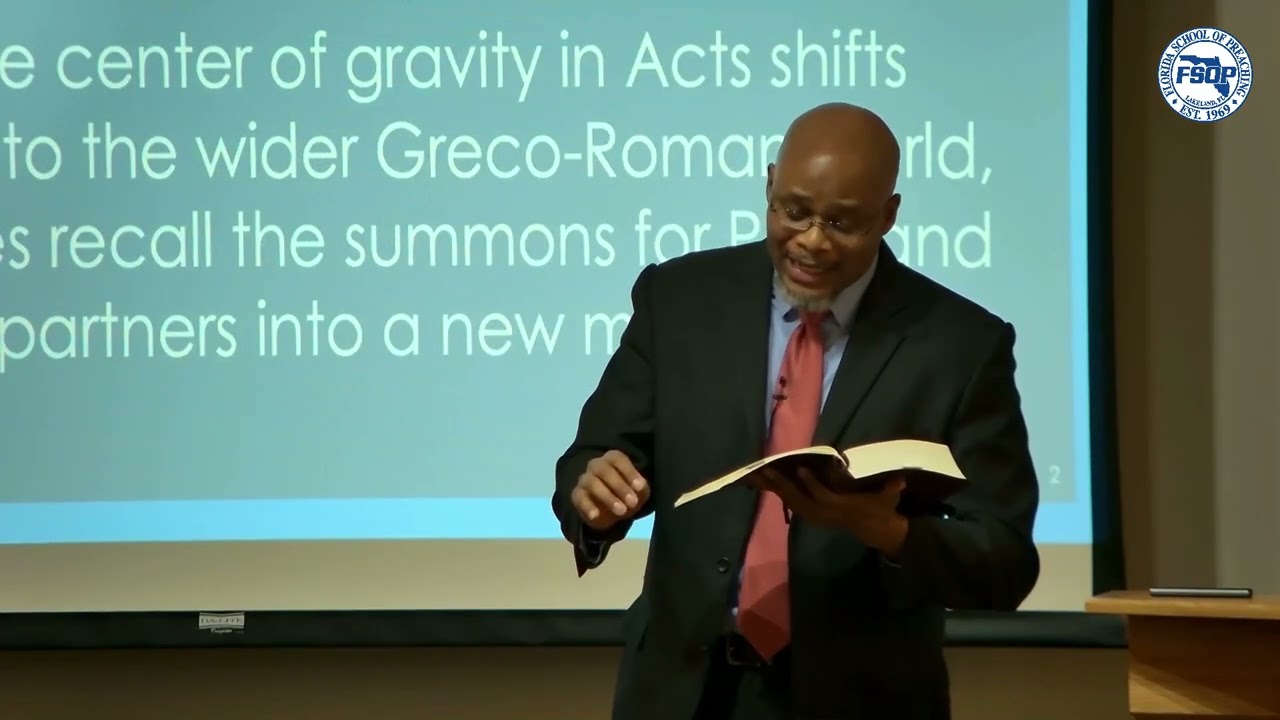
Jesus says in Acts chapter 1 and verse number 8, will be witnesses to me in Jerusalem, Judea, Samaria, and to the end of the earth. In Acts chapters 2 through 7 you can read about the going forth of the gospel in the city of Jerusalem.
Beginning in chapter eight, verse number one, we read in a summary form about the gospel going into Judea and then Samaria. In Acts chapter eight and verse number four, you read about the gospel going into Samaria in earnest throughout the rest of that chapter. We read about a man named Philip and he goes to that city. He performs miracles empowered by the Spirit of God. And then the Holy Spirit says to him to join himself to a chariot that’s occupied by a person we oftentimes call the Ethiopian eunuch. In Acts chapter nine, we read about a man named
name Saul of Tarsus being converted. And then in Acts 10 and 11, we read about the beginnings of the gospel going to the Gentiles. You’ll remember a man named Peter receives a vision and he’s being told by the Holy Spirit that he needs to go to a place called Caesarea so he can share the gospel with the centurion named Cornelius and those of his household. That is a Gentile population that he is called to speak to. He has to give account for what he has done in Acts chapter 11.
And then at the end of Acts chapter 11, we read again about this person named Saul, or at least his effects. That is, after Stephen had been stoned, some people fled from Jerusalem and they went as far as a city called Antioch in a region called Syria.
When the gospel goes there, at least initially, the folks are only going to share the gospel with the Jews because they’ve been dispatched from Jerusalem and they’re sharing the gospel with people they know, with people they’re most comfortable with. But we are told that there are some people who come from Cyprus and Cyrene and they begin sharing the gospel with the Hellenists or the Greeks or the Gentiles. When they do that, word gets back to Jerusalem.
And the church at Jerusalem dispatches a man named Barnabas to go to Antioch to encourage, to strengthen these Christians there. And so he goes, this man Barnabas, the son of encouragement. When he gets to Antioch, he begins to teach there, but then he travels a bit north and west into a region called Cilicia, because there’s a city there called Tarsus, and there’s a man there named Paul.
Barnabas goes and he gets Paul from Tarsus, takes him with him back to Antioch. And the Bible says there at the end of Acts chapter 11, that they labor in that church for about a year’s time, Paul and this man, Barnabas. At the end of the chapter, we’re told there’s gonna be a dearth of famine there in Jerusalem. And so the saints at Antioch dispatched Paul and Barnabas to go to Jerusalem to take support and relief there. And so they go.
At the end of Acts chapter 12, we’re told that they returned back to Antioch. Listen to me. In Acts chapter 13, beginning at verse number 1.
The Holy Spirit says, separate to me Paul and Barnabas. And this begins what we oftentimes call Paul’s first missionary journey. But really it’s the only missionary journey of the dynamic duo of Barnabas and Paul. They travel through the region of Galatia into the cities of Antioch, Pasidian Antioch, Iconium, Lystra and Derbe preaching the gospel there, establishing churches there, preaching to the Jews, preaching also to
the Gentiles when the Jews reject the gospel, Acts 13 and 14. This is going to be a pretty seminal time in the church because the gospel is moving. You can see it, Jerusalem, Judea very quickly into Samaria, and now we’re full-fledged into the Gentile lands. We’re in what we call Turkey today, Asia Minor. When that happens,
It had created some trouble for Peter if you remember when he goes to Cornelius’ house he has to give a count for that in Acts chapter 11.
Peter when Paul and Barnabas go and preach to these Gentiles there in Galatia it causes somewhat of a stir. They get back to Syrian Antioch and when they do the Bible says there were some who came from Jerusalem we sometimes call these folks Judaizers but they were Jewish Christians who were committed to Judaism and they were saying to these new Gentile Christians you must also be circumcised and along with circumcision came the keeping of the law of Moses. You must be circumcised if you
want to be saved that’s what they were teaching. They’re in the Antioch of Syria. Barnabas and Paul
The Bible says that Luke is a little understated here, had no small contention with them. They weren’t going to stand for that. And because they couldn’t settle this matter there in Antioch, the whole group moves now to Jerusalem and they take it to the apostles and the elders. We’ve got to have a decision about what the gospel requires for salvation. So the apostles and the elders discuss all of this together and they come into the decision. listen, Peter has something to say about it and James has something to
say about it. Paul and Barnabas have something to say about it. But in the end, the church decides, listen, we can’t bind the law of Moses on the Gentiles. We can’t do it.
If we’re going to maintain fellowship though in this expanding church geographically and ethnically, if we’re going to maintain fellowship, we need you Gentile believers to avoid the obvious tokens of idolatry. Stay away from foods that have been offered to idols and stay away from blood and stay away from animals that have been strengthened and avoid sexual immorality. But besides that, we won’t try to bind any of these things on you and the church rejoices. If you go back to Acts 15 and you read the letter,
The letter that they dispatched from Jerusalem is addressed to the church at Antioch and the region of Syria and the region of Cilicia. And so Paul and Barnabas take the letter back to Antioch. They take the letter back to Antioch. They share the letter with the church there and the church rejoices. The Bible says the church is strengthened there in Antioch. And while they’re there, Paul says to Barnabas, we should… ⁓
We should go again and we should share the gospel or the good news about this decision with the saints in the rest of this area. So they go to Antioch. But we got to go now further. We’re going to go to Galatia. And when we do that, there is a concern about taking John Mark. They can’t agree.
John Mark had come with them from Jerusalem and Barnabas had wanted to take them, but he had turned back when they went to Galatia on the first trip. Paul was not going to be very patient about that. He said, the man is not ready. He can’t go with us. And Paul and Barnabas, they separate. You know about that. But I want you to see what happens. Barnabas takes John Mark and he goes to Cyprus where he was from and they spread the gospel there. But friends, after this,
After Acts 15, we do not read about the apostles in Jerusalem anymore. After this, after Acts 15, we don’t read about Barnabas anymore. As a matter of fact, we read about James one time. After this, the epicenter of the gospel going forward in the book of Acts begins to center on the work of a man named Paul and his expansions to the end of the earth.
And so they have two teams now.
Paul takes a man Silas and they go and they share this letter in the region where they were. They share it in Syria. They share the letter now, go a little bit north, go back a little bit west, go back to where Paul was from. They share it in Cilicia. And that’s where the letter had been addressed. And I don’t want you to miss this because the Bible says that the elders and the apostles at Jerusalem said, it seemed good to us, listen to it, and to the Holy Spirit.
not to bind anything more than these things on you. Up until this point, the going forth of the gospel, the movement of the message was being dictated by the Holy Spirit of God. And that letter was addressed to Antioch, to Syria, and to Cilicia, and it had gone that far.
But when you get to chapter 16, the ⁓ decision is made to go on back into Galatia. Now friends, the Bible doesn’t say the Holy Spirit had said to do that. I didn’t say it was wrong. I just say the Holy Spirit didn’t say to do it. This was a human decision.
And they go through the region of Galatia and they go back to those same cities, Antioch, Iconium, Lystra, Derby. And along the way, as they go into that region of Galatia, trying to share with them the message that had come from the church in Acts chapter 15, they meet a man named Timothy, Paul takes Timothy. And now we have Paul and Silas and Timothy, Acts chapter 16, verses one through five. And the Bible says the churches there were being strengthened. I know, I know, I know.
That seems like a lot of background. But I want you to see something because I don’t want to jump in Acts 16 verses 9 and 10 and leave the context. You’ve got to appreciate the context in order to appreciate what is happening in Acts chapter 16 verses 6 through 10. Why don’t you open your Bible? You already got your Bible. Open your Bible. Acts chapter 16 verses 6 through 10. What I’d like you to do is read these verses with you.
And then I want to walk back through them and make a few observations. chapter 16 verses 6 through 10.
They went through the region of Phrygia and Galatia, having been forbidden by the Holy Spirit to speak the word in Asia. And when they had come to Missyia, they attempted to go into Bithynia, but the spirit of Jesus did not allow them. So passing by Missyia, they went down to Troas and a vision appeared to Paul in the night. A man of Macedonia was standing there urging him and saying, come over to Macedonia and help us.
And when Paul had seen the vision immediately, we sought to go into Macedonia concluding that God had called us to preach the gospel to them. First thing, verses six and seven.
We see that the Spirit of God is interrupting these travel plans. These are human travel plans. The Holy Spirit has not told them to do these things. Now they are in Galatia and they’re trying to do something good and the things that they’re doing, listen, they seem to be very good things. They seem to be very honorable things. They seem to be laudable, commendable things, but the Holy Spirit hadn’t told them to do these things. And so in verse number six,
We went through the region of Phrygia and Galatia. This is where they were when they picked up Timothy Phrygia and Galatia. Listen, it’s Galatia properly. The Romans called this Galatia in the eastern part of what we call Turkey. Now to the west, they call that Asia right there in the middle. There had been an empire, a kingdom in some time past called Phrygia. They split the remains of the kingdom of Phrygia and half of it was in the west with Asia and half of it was in the east with Galatia there in Phrygia.
in Galatia, we are passing through Phrygian Galatia, and listen to this, having been forbidden by the Holy Spirit to speak the word in Asia. When you read the book of Acts, you read about the Holy Spirit empowering people.
Sending people, authorizing people, directing people. That’s what you see with Philip in chapter eight. That’s what you see with Peter in chapter 10. That’s what you see with Paul and Barnabas in chapter 13 and 14. You see the Holy Spirit directing and then guiding and empowering people. But here, the Bible says the Holy Spirit tells them no.
You’ve never tried to do something that you thought was good and found that there was a closed door, but that’s what happens to them. They are being told, they’re being forbidden, listen to it, forbidden to speak the word of God in Asia.
Now from where they are to get to where they wanted to be, the West, which is going to be up against the Aegean Sea there, the province of Asia, to get there, they intend to take a southwesterly route. If they take in that southwesterly route where there was a major Roman road, they’re going to come across a city named Ephesus. Anybody ever heard of that? They’re gonna come across all of the cities that you read about in Revelations 1, 2, and 3. All of those cities that John is going to deal with in the book of Revelations, they’re gonna travel through that area.
And the Bible says the Holy Spirit tells them no.
Verse seven, when they had come up to Missyia, which is going to be just above the province of Asia. When they come up to Missyia, listen to this, they attempted to go into Bithynia. Now they want to go north up near the Black Sea to that region, that province of Bithynia, but the spirit of Jesus did not allow them. See, you don’t oftentimes read, you don’t oftentimes read about somebody saying, I want to go.
and share the gospel with someone and the Holy Spirit says no. But here we’re being told that that’s what they were told. Now listen, in verse six the Holy Spirit tells them no, you can’t do that. In verse number seven the Bible says the Spirit of Jesus, same thing, Holy Spirit, the Spirit of Jesus tells them no. Now this helps me understand something.
Sometimes the best laid plans of men are not the same as the plans that God has.
I say Paul is an intelligent man. He’s a dynamic evangelist. Barnabas had been a dynamic man and a fantastic evangelist and the Spirit sends them together into Galatia and they do much good. Here we’ve got a man named Silas well reported of by the brothers. We got a man named Timothy well reported of by the brothers and we’ve got the apostle Paul and they want to go preaching the gospel and the Spirit says no, they had done much good up until this point but the Bible says they and God were not on the same page, so no.
Okay, well that didn’t work. That didn’t work. We can’t go to Asia. I you what we’ll do. We’ll go up to Abathenea. The Holy Spirit says no.
The second missionary journey, which is what we’re reading about, the second missionary journey.
was not a straightforward matter where human beings simply looked at their resources, did some calculations, and decided they knew what was best. The second missionary journey didn’t play out quite like that because somehow God told them no. Now here’s the thing, y’all. The Bible doesn’t say how the Holy Spirit forbid them. The Bible doesn’t say how the Spirit of Jesus forbid them, but here’s what the Bible does say. They were forbidden. It didn’t work.
It didn’t work. And I’m going to tell you, I don’t personally believe the Bible certainly does not say, I don’t even think it suggests that they were told no in some miraculous way. They had plans, they tried to do certain things and the door was closed. They had plans, they tried to do certain things and the door was closed. And then in retrospect, as Luke is writing this, he says, you know what? God told us no. Door was closed. We couldn’t go that way.
So the spirit interrupts their plan. Verses six and seven. Look at verses eight and nine again. The Bible says, so passing by Missy, that is we tried to go and we could not go where we wanted to go. So we pass by Missy, verse number eight. They went down to Troas.
And a vision appeared to Paul in the night. A man of Macedonia was standing there urging him and saying, come over to Macedonia and help us. We pass by Messia, which is gonna be a little bit north of Asia. And we come down to Troas. Troas was a major port city. And it’s right there on the coast of what we call Asia Minor. Now, right there on the coast, just a short jaunt over to the country of Greece, we call it now.
was a short jaunt and it was usually used for travel back and forth between Asia Minor and Greece. Now, this was not the original plan that Paul and his companions had, but this is where they find themselves after the Holy Spirit says, no, and no again. Well, now we’re in Troas. What are we supposed to do here? The Bible does not tell us.
Maybe they’re doing some preaching there, but the Bible doesn’t tell us that. And it doesn’t seem that they spend a great deal of time there. They don’t have some grand ministry there. Now listen, in your New Testament, Troas is going to become a pretty important city when you read through there. Of course, Paul comes back there in Acts chapter 20. The Bible tells us he stayed in Troas for seven days and communed with them there on the Lord’s Day, on the first day of the week. But on this occasion, they do not seem to have done a great deal in Troas. What happens there…
is Paul receives a night time vision. The word vision.
times in your New Testament, 11 of those times it occurs in the book of Acts. Paul apparently has six visions in the book of Acts. And this kind of intensity of visions is only matched by the book of Revelation, y’all.
It’s an important theme what’s taking place in the book of Acts. Listen, these kinds of visions, these are revelations from God. These are directives from the Holy Spirit. And there is an intensity of that kind of activity in the book of Acts. The Holy Spirit is working. And so Paul receives a vision. And in his vision, there is a man. Bible says he’s a man of Macedonia.
Scholars sometimes quibble, well, how did he know he was a Macedonian? I don’t know, because he says, come to Macedonia. I don’t know that. That helps me. That gives me a good clue as to how they would realize who the man was and what he was about. Come to Macedonia. Listen to it and help us. Render aid. Be of assistance to us.
There’s some things that we don’t know. There’s some things that we can’t do and we need assistance. You come to Macedonia and help us. He doesn’t say what kind of help he needs y’all. But see the context is helping me understand the kind of need that he had. Because they had been trying to preach in Asia and the Holy Spirit said no. They tried to go into Bethany and the spirit of Jesus said no.
And while they get to Troas, what are we doing here? Here comes a vision. Come to Macedonia and help us. Sometimes scholars will say, you know, this was a dream. I don’t know that it was a dream. I mean, what’s the difference? A dream, a dream is something that happens when you’re asleep. And I don’t know for sure that Paul was asleep. But what I do know is when he received this message, it gave some impetus for this group.
They had been trying to preach in one area and found the closed door. Now, you know what? When they couldn’t preach in the area they initially wanted to go to, they didn’t stop preaching. They just went to another area. And when they found a closed door in that area, they didn’t stop preaching. They just went to another place. They went to Troas. And while they’re at Troas, the vision occurs and then they decide, you know what? I think God is trying to tell us something. Yeah.
Yeah, maybe you ought to, maybe you ought to consult him when you’re making your plans. You you light out on your own. You might be doing some good, but listen, you’re running into some things he doesn’t approve of. mean, the best plan you can come up with is not better than the one he has. There’s nothing wrong, nothing wrong with preaching in Asia, y’all. Nothing wrong, nothing wrong with preaching in Bethany. Nothing wrong. But you do it on God’s time. And sometimes this time is not your time.
That’s what they found out. I want you to see how they respond. In verse number 10, the text says, listen to this, listen to this. When Paul had seen the vision, how many people received this vision? Only one. When Paul had seen the vision in verse number 10, immediately.
we sought to go into Macedonia concluding that God had called us to preach the gospel to them. I want you to see something.
Paul receives this vision. He’s working with a team, a missionary team, right? We know at least that he’s got Silas there, and we know that he’s got Timothy with him. And then the we is the writer. Sometimes scholars wanna quibble about that, but listen, I don’t know. When you say we, that includes the person who’s speaking. The writer says we concluded at this point.
Luke is introducing himself into the narrative. This is one of the we passages in the book of Acts. Luke is an eyewitness to some of the things that happen and this is evidence of that. He says, when Paul received this vision, we concluded, that word concluded, when you look at the original term there, this is a coming together of the minds.
Paul got the vision, Paul is the apostle, but Paul shares with the others on his team, listen, this is what I saw in my vision and those minds who are part of the missionary team, they consult together and they collectively reach the decision. know, God is telling us he has something in mind for us that we did not have in mind for ourselves. He wants us to…
Get on a boat, y’all. He wants us to cross the Aegean Sea. He wants us not to just preach to some Gentiles here that’s near to us. He wants us to go into what we now call Europe and preach the gospel to people we’ve never seen, people who’ve never heard. He wants us to go a little further than we were intending to go. He wants us to stretch ourselves. And you know what they do?
immediately. They move. We concluded that God was calling us to go to Samaritan, go to Macedonia. Well, how you reach that conclusion?
Well, we tried to do this and it didn’t work. Closed door. We tried to do this over here and it didn’t work. Closed door. And then at a time and in a place that we did not necessarily expect to be, door opens wide for us. Well, this is providence of God. We looked at it, we thought about it, we kind of paid attention to our circumstances and we conclude this is the providence of God. I want you to see something.
They get on that boat. They go over to Europe, we call it. And now we think of Europe as being a different continent. It’s not a different continent, y’all. It’s the same landmass. But they go to this region, this part of the world where the gospel hadn’t gone yet. And because they got on that boat, we read in our New Testament about places like Philippi. And we read a letter written.
to the Philippians. We read about Thessalonica and we have two letters written to the church at Thessalonica. We read in the book of Acts about a group of Christians at Berea and the Bible says they were more noble.
than those in Thessalonica. We read about that because these men listened to the vision and got on the boat and went to a place they hadn’t been before. They answered the call in the vision to go to Macedonia. We read about Paul to Corinth and preaching in a place called Athens. Listen, we read about all of that because these folks went further than they intended to go because they listened to God and went where he said to go.
I believe Paul and Silas and Timothy had a good plan. Listen, they wanted to do the right thing. We just want to preach. But they were determined to preach where they wanted to preach. And the thing is they needed to be adaptable so they could go where God wanted them to preach. Sometimes those are not the same, y’all.
Paul saw the vision and so they all responded. They all agreed and there was a commitment on their part. It’s not about preaching where I want to preach. It’s not about going where I’m comfortable going. It’s about going wherever God opens a door.
Now, I want you to think about something. How many people were blessed because these folks listened to God and adapted their plans, changed, listen, my preference is to be here.
But I can see that God wants me over there. How many people have been blessed because of that? Now, I want you to think about a few things. As you think about that episode, I want you to think about what this might mean for you and for me. I think sometimes we get it in our minds that if I have a determination in my heart to do something,
and it doesn’t work the way I want it to happen. Listen, if I can’t do it the way I’ve always dreamed, the way I have planned for it to work, that somehow or another that makes me a failure of some kind. Listen, that is a frustration that I can’t do it the way I want to do it. But sometimes that’s not a sign of failure, but that’s God trying to communicate to you. That’s not how I want it. I have known men preachers who just kind of had their heart set on preaching.
with this particular church, door doesn’t open. Are you gonna stop preaching?
I say you made it, you were gonna force it. And so you got in there and you’re gonna force it and then it’s nothing but trouble. And now you’re outta there.
You gonna stop preaching? Or are you going to be persistent and flexible? If I can’t preach it there, listen, if I can’t go to Missy, I’ve heard that they need some gospel up in Bethany. That’s where I’m going.
I have heard of people whose heart’s desire and prayer to God was that this person right here might be saved. I’ve got a spouse, I’ve got a child, I’ve got a parent, I’ve got a loved one, and I don’t want anything more, nothing more than for this person to be saved. You know what? God wants him saved too. But you might not be the person. You might not be the person.
And what I’m saying to you is, if you cannot preach to that person, are you gonna stop preaching?
Or are you gonna be flexible? Or are you gonna be adaptable? If this door closes, are you gonna look for the open door and go through that one? Or are you gonna sit there and kinda commiserate and complain that it’s not working the way you want it to work? The gospel went to Ephesus, y’all. It didn’t go on Paul’s time, but it went. It went to all those cities you read about in Revelations 1, 2, and 3. It didn’t go on Paul’s time, but it went. It might be for somebody else to do that.
So we have to be, listen, we have to be receptive to the idea that we are not going to receive the kind of miraculous revelations that Paul received. But I’m saying to you, sometimes it was not a matter of miraculous revelation. It was just that they tried to do something and it didn’t work.
You know, if I have to get to the door and find out that it’s locked, I know the Holy Spirit didn’t send me to the door. I just went to that door and that wasn’t the one he told me to go to. They got there and the door was closed, the door was locked. So they just had to be flexible. We’re not going to, like I say, receive miraculous revelations. Sometimes we’re going to be told no, and it won’t be an audible no. It’ll just be that what we’re trying to do is not working. And I’m saying to you, friends, that’s okay. Yeah, that’s okay. Sometimes what we’re trying to do
may not be working but what i do find is if that’s not working i don’t stop working did you hear what i said if that’s not working i don’t stop working i think sometimes that’s what people do you know what our congregation we had a plan and we were going to do this and that and we put a lot of resources into it and we tried this particular program and it just didn’t go anywhere you gonna stop working
We went into this neighborhood, we knocked on all these doors and we invited people to come and we put all this stuff on social media. We invited people to come and we were gonna have a meeting and nobody showed up. Are you gonna stop working?
Sometimes when you try something that doesn’t work, that’s just a no. But I want to caution you about something. Don’t give up too quickly. Because we will use a no as an excuse to stop trying. And I didn’t say that at all. Listen, Paul said, listen, I’m going head down here. And he couldn’t get that done. He said, I’m going to just shift a little bit and go and I’m going to try this way.
And he kept on trying, he kept on trying until it became clear to him that there was an open door somewhere else and then he took it. Sometimes we run into frustrations and we think, well, listen, I asked the person to come one time and they wouldn’t come. So that’s it. guess, no, listen, that’s not it at all. You know, if you read the things that Paul endured to preach the gospel, you know, Paul didn’t quit the first time. And I’m saying to you, you don’t get to quit the first time.
I tried to have a study with somebody and I showed it to them just as plainly as I can show it to a person and they wouldn’t accept it. Are you going to quit?
You don’t give up entirely. You keep trying until an open door comes somewhere else. And that’s what happened for Paul. See, there was an open door. So what I’m saying to you is I’m sitting here trying to talk to this neighbor, doing the best I can to convince them to have a study with me or to end the study to obey the gospel. And they’re not accepting it. I’m saying to you keep trying. But listen, if you won’t get anywhere over here and you see another opportunity, go and visit that other opportunity. It may be God’s time.
for somebody else. It’s your time for this person. It may be God’s time for this person. And after you convert that person, then you come on back to this one. Something else to keep in mind.
You are not necessarily going to receive an invitation to travel to some other part of the world. That is, your Macedonia may not require you to get onto a boat.
That’s okay. That’s all right. Listen, I know there’s some folks here who travel halfway around the world to do mission work. I think that’s fantastic. Can you travel up the street to the grocery store? How about you do some mission work up there? Can you travel down the street to the school in your neighborhood? How about you do some mission work over there? See, your Macedonia may not require you to take a plane or a boat. It may simply require you
to extend yourself to establish a relationship that’s outside of your comfort zone. I’m familiar with the people over here. I’m comfortable with the people over here. Yeah, but God may want you over here to talk to somebody you’re not necessarily inclined to talk to. Doesn’t look like you. Doesn’t think like you. Hold on a minute. Doesn’t vote like you.
Doesn’t live in a part of town you live in. But see, that may be God’s time for them. Are you willing to listen and be flexible and adaptable? I’m committed to this job. I’ve been working on this job this long and guess what? That job’s not there anymore. Are you gonna be flexible? Adaptable? Maybe your Macedonia is a new job. Maybe your Macedonia is a new city. Something beyond your comfort zone. Something beyond what you would design for yourself.
But when you look up and here you are, the door is open. Don’t stop preaching. That’s what I’m saying. Yeah, you have a plan, but your plan is not better than God’s plan. And I don’t expect, I don’t expect that when I go home and I shower, God is going to reveal his plan to me in a miraculous way. No, ma’am, no, sir. I just keep trying. And when I find an open door, I know at least by God’s providence, that’s where he wants me, because the door is open.
I want to make a suggestion to you. A couple of things that I see about how Paul and his companions operated that would be helpful for us to remember as we try our best to expand the gospel into areas that we may not be working in now, into relationships, into communities, into parts of the world where we may not be working in right now. Number one.
You have to be attentive when there’s not a good opportunity. Sometimes we beat our head against a brick wall and then we become frustrated because it’s a brick wall. Listen, stop beating your head against it. Sometimes no is just no. And when Paul couldn’t get it done here, you know what? He just went to another area. I’m saying that needs to be something that we internalize. Here’s something else.
When you see what appears to be a good opportunity, how about you discuss, you consider, and you deliberate in community with other spiritually minded people? I’ve known folks who make significant decisions all by themselves. And I think to myself, you mean your wife didn’t have any thoughts?
You mean, listen, you mean your children didn’t have any insight? The church where you worship didn’t have anything to contribute? Who are you going to be working with? They don’t have anything to… Listen, Paul is the only one who got the vision. Sometimes you’ll be the only one who gets the invitation. But before you accept it, let’s have some conversation with the other stakeholders.
spiritually minded people and see what insight they have. And when we make our decision as a community, I tell you, we make better decisions when we do it that way.
If you keep reading in the book of Acts, what you’ll find, they go to Greece and they preach the gospel all up and down Greece in Macedonia and then down into Achaia. But they come back. They come back to Asia Minor. Paul does go back to Ephesus. You just keep reading a couple of chapters. He does go back to Ephesus and gets to preach in those areas where they had tried to go before.
Just because God won’t let you do it now, that doesn’t mean he won’t let you do it at all. He gotta do it on his time.
This is a, it really is an impressive episode to me because I oftentimes hear folks, know, Macedonian call, Macedonian call, and I get it, but I don’t think people appreciate where this call fits in to the progression of the gospel. When it was time for a dynamic move to be made for the explosion of the gospel, for the epicenter of the gospel to move from Jerusalem
to Antioch into Europe. God did that. See our best plans. We can dream as big as we want to y’all and I believe in dreaming big. We can dream as big as we want to. But if the plans we have are going to come to fruition it will only be if God does that. And this is why after X 15 it’s not Jerusalem anymore y’all. It’s not Jerusalem.
It’s Antioch. And after Antioch, I want you to see this. This becomes a new period of independence for the Apostle Paul. The church at Jerusalem is sending people out, sends Barnabas out. The church in Antioch sends Paul and Barnabas out, sends them to Galatia and they come back, sends them to Jerusalem and they come back.
But at this point, Paul is no longer working with directly any of the apostles in Jerusalem. He’s not working with Barnabas anymore, not directly. And he’s not being directed at the church at Antioch.
This is a new phase of maturity and expansion in his ministry. And this is how it can be in your life. When you’re getting started you need a lot of direction. Maybe you need a lot of handholding. You need a lot of assurance. But if you will simply be committed and keep working at some point you grow to a place where when I see a person who wants to be taught I just go.
I don’t have to ask anybody to go with me. I don’t have to ask, I just go because I’ve been working at this. I’ve been practicing this and I’ve had people help me along the way and I’ve gotten to a place in my walk where when I see a door open, I go right through it. And that’s what Paul does and the gospel explodes that way.
I think everybody in here would do really well to think about things that might seem uncomfortable to you. And think about your willingness to be flexible and adaptable and to go beyond the plans you have in your mind and see what doors have been opened for you providentially and your willingness to walk through them. I’m going tell you something.
If you do it the way God wants you to do it, you won’t walk past five people trying to find the one that you think is ready. So you got to get outside of your comfort zone. Everybody you speak to is not going to look like you. It’s not going to speak like you. It’s not going to vote, think politically the way you think.
It’s not going to be in your socioeconomic bracket. Listen, if you do it the way God wants it done, you just keep looking for open doors and as soon as one is open, you exploit that door. You go through it.
Everybody in here has a Macedonian call. That’s what I’m trying to tell you. Everybody. Don’t wait. Don’t wait to see if you need to take a mission trip halfway around the world. Take a mission trip next door to your neighbor. And maybe other doors will open, and when they do, you go through those. But start there, where you are. That’s what Paul did. Start where you are. It’s possible that someone in our midst, see?
actually is trying to make a Macedonian call of their own. I didn’t say they were the ones who were receiving the call. I’m saying there may be folks in our midst who are extending a by being here. Paul receives a vision and it’s a man of Macedonia saying, come and help us. And I’ll tell you in our churches from week to week and maybe even here tonight, there’s folks who are here because they’re inviting help.
Yeah, if you are here and you are not a Christian, we’re thankful that you are here because you are by your presence saying that you would like some help. And I’m going to tell you something. There are a lot of people in this room who will be very happy to help, very happy to sit down with you, open the Bible with you and show you how God takes care of your sin problem.
and all the kinds of ravages, the problems that sin causes in your life. God has a prescription for that and you are surrounded by people who know what it is. Listen, we’re gonna, in just a few moments, we’re gonna stand and we’re gonna sing a song. And if you’re not familiar with it, this is our tradition. We sing a song, we call it the Song of Invitation. And what we do when we do that is we make room for people who would like help to come and make us aware that they would like our help.
It would be our profound privilege to pray with you. It would be our profound privilege to study with you. If you have a need, bless us, please, by letting us know how we can help you with your need. Jesus is the Son of God. That’s what Paul and Barnabas were doing when they were preaching in Galatia. That’s what Paul and Silas were doing. They were telling folks about Jesus. Jesus…
is the Son of God. He died for your sin and for mine. Because he did that, we can live new lives. See, I don’t know what kind of life you’re living right now. I don’t know. I don’t know what kind of life you’re living when you leave this building. But here’s what I do know. There’s a better life in Christ and it’s available to you. Do you believe in Jesus? I say, do you believe in Jesus? If you believe in him, what do you believe?
The Bible says he’s the son of God. What do you believe? Because if he’s the son of God, then you have to accept that he says all authority is given to me. Listen to it. In heaven and on earth. If he has all authority in heaven and on earth, y’all, there’s no power left. He has it all. Do you believe that? Do you believe that if he has all authority in heaven and in earth, he gets to tell you what’s best in your life? Do you believe that?
If you believe that, you have to repent. Repent, I know it’s a fancy word. It just means change, y’all. Change your mind, change the way you think. If you believe Jesus has all authority, then what that means is if he ever says he wants me to do something different, then I have to change. God is not going to change his mind. If I want to be on the same page with God, I’ve got to change my mind.
I know there are some things in my life that are not in keeping with what God wants for me. I know there’s some things in your life Jesus died to take out of your life. Are you willing to change? You can’t be saved unless you do, y’all. You can’t say, believe in Jesus and then say, I’m not willing to do what Jesus says. Then you don’t believe. Then you don’t believe because if he has all authority, that means he has authority for you as well. Repent of your sin. Confess Jesus with your mouth.
Why confess? I know the Bible says, Jesus says, if you confess me before men, I’ll confess you before my Father in heaven. He says that. And that involves more than just saying with your mouth. He’s talking about also your lifestyle, how you’re going to conduct yourself in the world. The Bible says, Paul says, confession moves you closer to being saved. Yes, it does move you closer to being saved. But here’s the deal. If you want to be baptized to have your sin washed away, you have to tell somebody.
I believe in Christ and I want to be baptized to have my sin washed away. We are in the baptizing business. God is in the saving business. We cooperate with God by baptizing people who believe in Jesus. We are in the baptizing business. Jesus said, go and make disciples, baptizing them.
teaching them all things that he’s commanded. We are in the baptizing business because that’s part of the disciple making business. If you would like to be saved, we would like to help. You tell us, do you believe? Because it’d be our profound privilege to help you become a disciple of Christ. And baptism, well, that’s going to be required for you to be a disciple of Christ. We’re going to stand together and sing a song. This is a song of invitation.
It could be that you are a Christian, you need prayer, you need help, you need assistance in your walk with God. We would like to pray with you and for you. It could be you’re not a Christian and this is uncomfortable for you. You’re not used to this kind of thing. Listen to me. Have enough courage to do this, even if it’s uncomfortable. Have enough courage.
to make yourself known to us that we can help you and let us do the rest. You have enough courage to let us know that you need help and let us do the rest. Jesus Christ is the Son of God. In His name, we invite you to come.
Will you come as we stand together and sing this song of