 Alumni
 FSOP Ladies
 Harvester & Articles
 Harvester Podcast
 Lectureship
 Lectureship Audio
 Lectureship Video
 Debate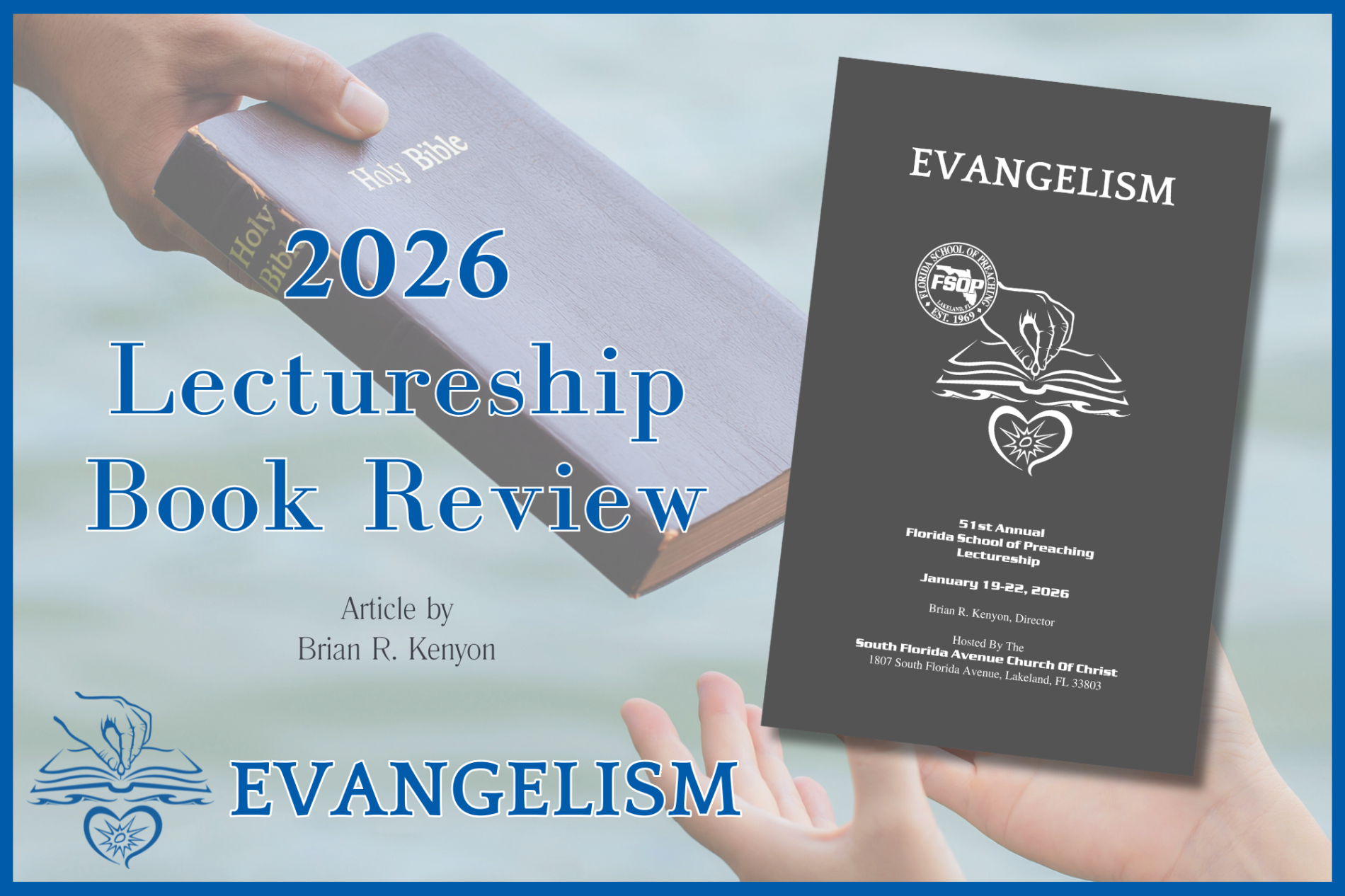
By Brian R. Kenyon
Our Fifty-First Annual Lectureship was a great time of focused study and fellowship. It was very well attended by faithful church family from all over the United States and a few international visitors. In fact, our opening session was the largest I have ever seen! Of course, the reason may have been the significance of the topic. Evangelism is a much needed topic to study and a much more needed activity to be done as a natural ingredient of individual Christianity! Below are some excerpts from the lectureship book. The book is currently available electronically. Hard copies are on the way and will be mailed to pre-orders as soon as they arrive!
Cary Gillis, in his chapter titled “Evangelism Must Be Deliberate,” writes (pages 351-352):
Evangelism is the action of making the gospel message of Jesus Christ intersect with someone’s life. It is the endeavor of causing those who are hiding their faces from Jesus [cf. Isa. 53:3] to look Him in the eyes, reminiscent of Peter denying Jesus and then immediately looking across the courtyard of the high priest and meeting Jesus’ eyes looking right back at him (Lk. 22:61). As with Peter, evangelizing means helping someone own their guilt. Only through taking ownership of the guilt of His blood can someone embrace the grace of His blood.
Evangelism means showing the world the reality—the bad news with the good—that they are the enemy of a God who wants to save them. They are guilty of the very blood that was spilled to make them innocent. Ideally, evangelism will bring someone along the trajectory of Peter’s arc, denier of Christ to proclaimer of Christ. … Here is a simple breakdown of the title of this lesson. “Evangelism,” as described above, is the act of causing the good news of Jesus to intersect with someone’s life. “Must” denotes an imperative. This is not optional. “Be Deliberate” means it does not happen by accident. It is the result of an intentional plan.
One of the biggest challenges to preachers being more evangelistic is the fact they are very busy. Much of the time they are doing jobs that should be distributed among other church members, but that is a separate lesson for another time. Hiram Kemp, however, wrote a chapter titled, “How Busy Preachers Can Still Evangelize.” As great as a preacher Hiram is, I have always been more impressed with his “Monday through Saturday” local work. He constantly has one-on-one Bible studies throughout his busy week, resulting in numerous baptisms annually. He writes (pages 420-421):
If the gospel will go forth in all of its power and capability in our generation, we must be busy sharing it with our family, friends, and neighbors (Rom. 1:16-17). Sharing the gospel involves more than a billboard announcement of Jesus as King or even a Facebook status that lists the plan of salvation. Instead, sharing the gospel means we will have to engage in Bible studies with the lost in our midst. Individuals must be walked through Scripture as they are taught what God expects of them from God’s word. This involves one flesh-and-blood person teaching someone and making time to ensure the teaching can be done (cf. Acts 1:8). While everybody in the local church can and must be engaged in evangelism in some way, shape, or form, those charged with the responsibility of preaching should be on the front lines in this work. Paul told Timothy to do the work of an evangelist (2 Tim. 4:5), and that included preaching the word at various times (2 Tim. 4:2).
There are many stereotypes, when it comes to evangelists and evangelism. These stereotypes often make evangelism more difficult than it needs to be. In Rick Kenyon’s article, titled “Debunking Evangelism Stereotypes,” he writes, concerning the myth, “Baptisms Demonstrate Effective Evangelism” (pages 224-225):
Paul said, “For Christ did not send me to baptize, but to preach the gospel” (1 Cor 1:17). While we may never hear anyone say, “Baptisms are the goal of evangelism,” let us beware lest our emphasis on baptism speaks that sentiment for us. When our evangelistic efforts result in a new birth, there is all the reason in the world (and heaven) to rejoice. Yet, baptizing people is not the goal nor the ideal result of evangelism. The ideal result of evangelism is bringing people closer to God and helping them maintain that growth. God’s word works in their heart as God works through us by using our opportunities and relationships.
Baptism is never the end of that process. If anything, it is the beginning. A new birth requires much more follow-up and attention than the spiritual “prenatal” care brought about by Bible studies leading up to a baptism. For some, evangelism is spiritual mid-wifing. They engage in studies with people who might be close to their new birth and gladly walk them through it until their baptism. There may be a few check-ins post-baptism, but the spiritual midwife’s job is complete. A new Christian is born!… now to the next one. Paul affirmed, “I planted, Apollos watered, but God gave the growth” (1 Cor. 3:6). Those who are blessed to assist in leading people to the baptistry cannot claim any more “effective” in evangelism as those who quietly and consistently water and plant. Frequently witnessing a key developmental step in one’s walk with God does not mean that one has the lockdown on effective evangelism.
Engaged members of local churches of Christ are in many ways the key to evangelizing a community. Dylan Johns, in his chapter titled, “Internal Local Church Evangelism,” writes (page 415-16):
Telling Christians to evangelize without equipping them to do so can only leave us discouraged. Training makes evangelism feel accessible instead of intimidating. There are two major areas that need to be in place to accomplish this. First, provide evangelism training. Practice starting conversations, using study guides, and answering common questions. Role-playing helps us grow comfortable speaking with atheists, religious neighbors, or curious family members. Second, provide simple tools. Have available business-card-like invitation cards with service times and information about the church, evangelistic booklets or correspondence courses, and links or QR codes to sound online resources.
There are simple things that every Christian can do to become more evangelistic. First, get to know people in our lives. Ask questions and learn where a person is spiritually. Second, organize contacts. Keep a simple list of prospects and follow-up needs. Third, practice. Paul taught we must “know how to answer each one” (Col. 4:6), and Peter urged every Christian to “make a defense … for the hope that is in you” (1 Pet. 3.15). These things do not happen by accident. Training, planning, and preparation must be woven into our congregational life so evangelism feels normal rather than awkward and anxiety-inducing.
These are just a few excerpts to show what this book brings to the table of being better evangelists. Order your copy today!